AI Receptionist for Dental Clinic: Cost, Setup & ROI (2026)
The honest guide for dental practices thinking about AI call answering
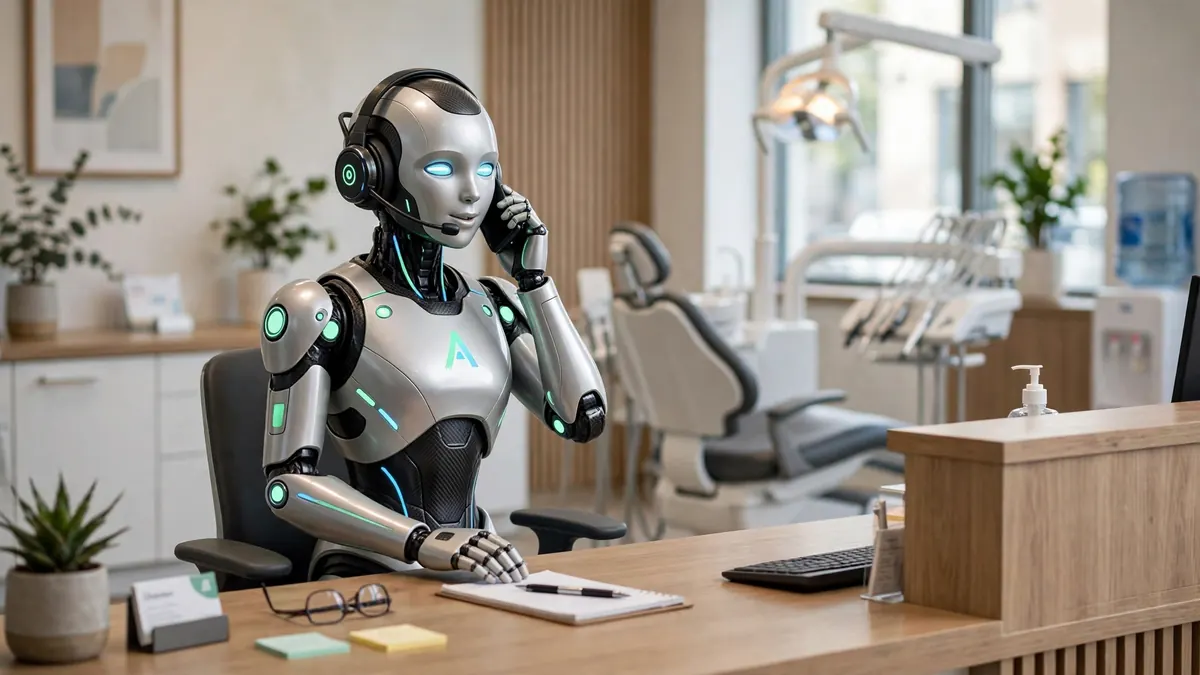
If you run a dental clinic, the phone always rings at the worst moment — you're mid-procedure, the front desk is with a walk-in, or it's Saturday and the practice is closed. The caller doesn't wait: new patients simply call the next clinic on Google.
This guide covers what an AI receptionist for a dental clinic actually does, what it costs in 2026, how a proper setup works, and whether the math makes sense for a practice like yours. No vendor hype — just the details that matter.
What is an AI receptionist for a dental clinic?
An AI receptionist is a virtual phone agent that answers your practice's calls in a natural voice, 24 hours a day. For a dental clinic, it is trained on your practice: your services, your hours, your pricing, and your booking rules. A typical one can:
- Answer every call instantly — including evenings, weekends, and during procedures
- Book appointments into your calendar or practice software, with your appointment types and rules
- Answer common questions (hours, location, insurance accepted, what to do before an extraction)
- Send new patients intake forms and directions by text
- Flag emergencies using your escalation protocol — and transfer to a human when a caller asks
The missed-call problem in dental practices
One dental AI vendor reports that clinics can miss 30–40% of calls during procedures. And a new patient who hears voicemail rarely leaves one — they call the next practice. Every unanswered call is potentially a treatment plan walking to a competitor. (Our full breakdown of this math, across industries, is here: How much do missed calls cost your business?)
What does it cost in 2026?
There are three broad tiers:
- DIY platforms, roughly $29–$99/month. You set everything up yourself. Basic call answering works, but booking integrations, emergency routing, and practice-specific training are often missing or shallow.
- Vendor plans with minutes bundles, roughly $100–$400/month. Better reliability, but you still configure the clinic's workflows yourself, and overages can surprise you.
- Done-for-you agency setup, like ours: $1,000 one-time setup + $500/month. The setup fee covers the work most practices don't have time for — call-flow design, training the AI on your FAQs and protocols, booking integration, and a live test before go-live. The monthly covers the AI calls, maintenance, and updates.
For context, a full-time human front-desk receptionist typically costs around $2,500–$4,000/month in wages alone, according to a 2026 industry breakdown by trtc.io — before benefits, training, and sick days. The AI is not a human, but the price gap explains why practices are moving this way.
How setup works: 5 steps
- Call-flow design — we map what happens on every call type: new patient, existing patient, emergency, price question, spam.
- Knowledge base — your services, hours, pricing, insurance, policies, and FAQs go into the AI's training.
- Booking rules — which appointment types exist, how long they take, buffer times, and who can book what.
- Emergency protocol — keywords that trigger instant escalation to your on-call number.
- Go-live test — we place real test calls, fix anything that sounds off, and only then switch your line over.
This is the part a $29/month DIY tool skips — and it's the part that makes patients trust the system.
ROI: a worked example
This is an illustrative example, not a promise — but it shows how clinics think about the math.
Say the system recovers just 6 extra new patients a month who would otherwise have called a competitor.
Suppose the average new patient is worth about $400 in first-year treatment value.
6 patients × $400 = $2,400/month in recovered revenue
against a $500/month service cost
Most practices break even if the system recovers just one or two patients a month. Everything beyond that is treatment revenue the clinic was previously losing to voicemail.
Frequently asked questions
Will my patients know they're talking to an AI?
The AI introduces itself as your clinic's AI assistant, so you're never hiding anything. In practice, callers care about one thing — getting booked quickly — and practices that are transparent about it get the best reception.
What happens with a real dental emergency?
It follows your emergency protocol: recognizes emergency keywords, collects the patient's details immediately, and escalates to the on-call dentist or a real person without delay.
Will it replace my front-desk staff?
No. It removes the constant phone interruptions so your team can focus on the patients in the chair. Most clinics keep their staff and let the AI handle after-hours and overflow calls.
Can it book into the software we already use?
Yes — done-for-you setups connect the AI to common scheduling and calendar systems during setup, mapping your appointment types and confirmation workflow.
Hear it answer a call for your clinic
Book a free demo and hear an AI receptionist handle a real dental-clinic call — trained on your practice.
Book a Free Demo →